
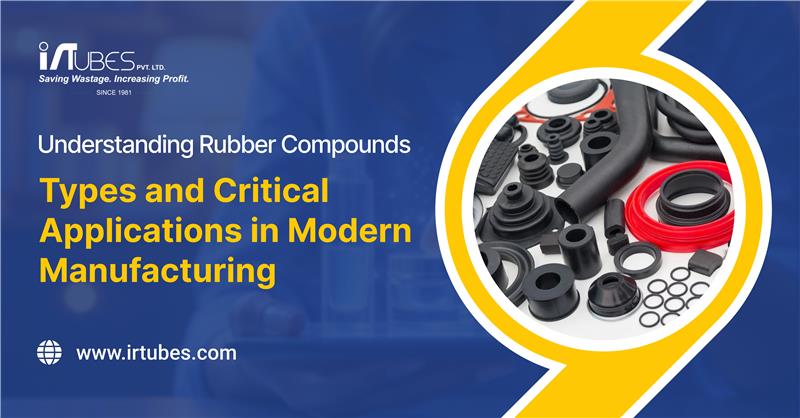
The science behind rubber compounds extends far beyond simple elasticity. At I R Tubes Pvt Ltd, our work in polymer chemistry demonstrates that modern rubber applications demand precise engineering of molecular structures, filler systems, and curing mechanisms to meet increasingly stringent performance requirements across diverse industries.
The Chemistry of Rubber Compounding
Rubber compounding consists of systematic blending of base polymers, reinforcing fillers, vulcanization aids, and processing aids. The vulcanization process—via sulfur-promoted cross-linking—forms three-dimensional polymer networks that facilitate elastic recovery upon deformation with dimensional stability. Without such molecular architecture, rubber materials would lack the mechanical properties required for demanding industrial applications.
Natural Rubber: Engineered Performance
Natural rubber latex shows strain-induced crystallization—on rapid deformation, polymer chains orient and reinforce the material temporarily. Its longstanding dominance of high-stress applications like aircraft landing gear and heavy-truck tires is due to this self-toughening phenomenon. Aviation-quality natural rubber compounds need to resist touchdown loads at 180 mph with retained flexibility at -40°C for high-altitude applications.
However, natural rubber is not resistant to petroleum products, hydraulic oils, and industrial solvents, and thus needs synthetic alternatives to survive aggressive chemical environments.
Synthetic Rubber: Application-Specific Solutions
Nitrile Rubber (NBR)
Nitrile Rubber (NBR) is the benchmark by which chemical-resistant sealing is judged. Its polymer backbone contains acrylonitrile, which gives outstanding resistance to petroleum-based liquids and hydraulic oils. Fuel system seals made from optimized nitrile compounds retain functionality for decades under constant hydrocarbon exposure.
Styrene-Butadiene Rubber (SBR)
Styrene-Butadiene Rubber (SBR) became the dominant tire production material due to uniform batch-to-batch properties. Unlike natural rubber, SBR provides consistent performance essential for mass production.
Fluorocarbon Elastomers
Fluorocarbon Elastomers work continuously under 400°C temperatures but remain flexible even at -65°C. These materials are resistant to nearly all chemicals used in industry and have necessary applications in aerospace sealing devices and chemical processing machinery.
Also read: How to Stop Porosity in Rubber Curing Without Sacrificing Performance
Critical Industrial Applications
Automotive Systems
Contemporary automobiles employ 300+ rubber elements. Sealing systems for electric vehicle batteries need to restrict moisture entry while allowing thermal cycling associated with charging operations. Seals for battery packs go through 200,000-cycle fatigue testing to simulate a decade of service.
Medical Device Requirements
Healthcare applications impose stringent biocompatibility requirements. Heart valve components must function reliably for 20+ years under continuous flexing in blood contact, while surgical glove compounds must balance tactile sensitivity with barrier protection against bloodborne pathogens.
At I R Tubes Pvt Ltd, our compound selection methodology identifies the most demanding application requirement and builds formulations to address that primary constraint, delivering superior performance in actual service environments.
Advanced Processing and Quality Control
Contemporary compounding plants utilize accuracy-mixing equipment providing even dispersion of fillers and additives within the polymer matrix. Statistical process controls measure key parameters such as Mooney viscosity and cure behavior, thus detecting formulation drift early on. Sophisticated analytical tools like dynamic mechanical analysis offer in-depth description of compound performance under simulated service conditions. Material traceability systems monitor each component from receipt of raw material to delivery of the final product, enabling quality assurance demands in regulated markets such as medical and aerospace use.
The CEO’s Perspective: Engineering Reliability Through Innovation
At I R Tubes Pvt Ltd, our philosophy has always been anchored in one principle: performance engineered through precision chemistry. Every compound we develop is not merely a formulation but a result of decades of material science expertise, collaboration with OEMs, and continuous process innovation. In today’s industrial landscape, the demand is not just for durable rubber, but for materials that think that respond predictably to stress, temperature, and chemical exposure.
We feel that innovation is rooted at the molecular level. Our teams combine polymer science with data-driven testing to provide compounds that comply with worldwide regulatory requirements but supersede customer expectations in reliability and longevity. We collaborate closely with each customer to understand their unique challenges, whether it’s extreme temperatures, aggressive chemicals, or demanding pressure conditions and engineer tailored solutions that address their exact specifications. Whether it’s ensuring the chemical resistance of sealing systems or achieving the fatigue endurance of dynamic components, our focus remains unwavering to: engineer trust into every molecule.
At the heart of I R Tubes’ mission is a commitment to sustainability, consistency, and performance leadership. As industries evolve, our compounding technology evolves with them, helping our partners achieve safer, smarter, and more efficient operations without compromise.
About I R Tubes Pvt Ltd
We specialize in advanced rubber processing chemicals and custom compound development for demanding industrial applications. For technical consultation, visit IRTubes or contact our engineering team.
Raju Jethmalani
IRTubes Pvt. Ltd., Pune