
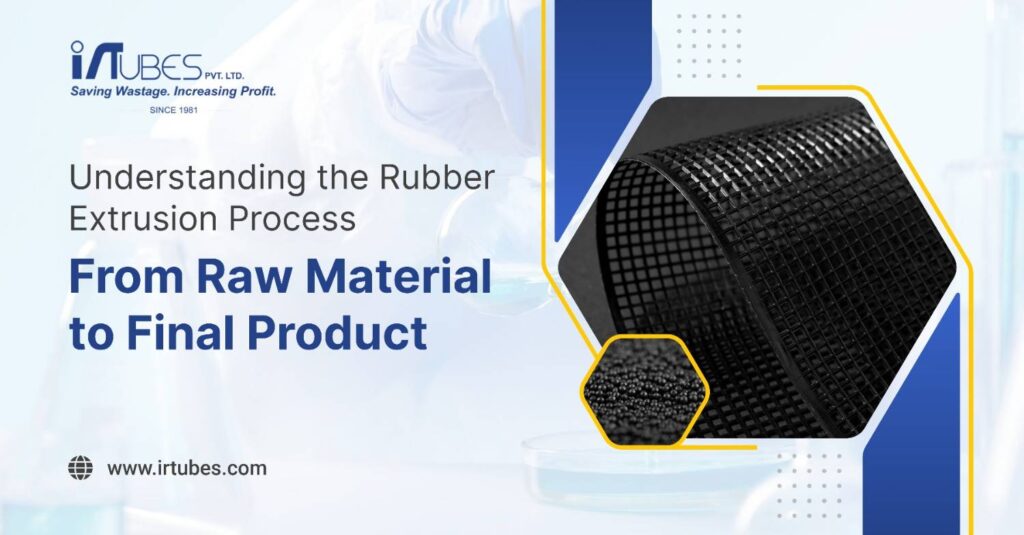
Rubber extrusion is one of the most efficient and widely used manufacturing techniques in the rubber industry, transforming raw elastomeric compounds into continuous profiles with consistent cross-sections. From automotive seals to industrial gaskets, this process enables manufacturers to produce high-quality rubber products at scale. At I R Tubes Pvt Ltd, we leverage decades of experience in rubber compounding to help manufacturers optimize their extrusion processes through precision-engineered specialty chemicals.
What is Rubber Extrusion?
Rubber extrusion is a manufacturing process where uncured rubber compound is forced through a precisely shaped die under heat and pressure to create continuous lengths of rubber profiles. Unlike molding, which produces individual pieces, extrusion generates long, uninterrupted profiles that can be cut to required lengths, making it ideal for products like weatherstripping, tubing, seals, and gaskets.
The beauty of this process lies in its versatility—manufacturers can produce everything from simple circular tubes to complex custom profiles with intricate geometries, all while maintaining tight dimensional tolerances.
The Four Essential Stages of Rubber Extrusion
1. Material Selection and Preparation
The extrusion journey begins with selecting the appropriate rubber compound based on the application requirements. Different elastomers offer distinct properties:
- EPDM rubber excels in weather resistance and outdoor applications
- Nitrile (NBR) provides superior oil and fuel resistance
- Silicone rubber handles extreme temperatures and maintains flexibility
- Neoprene offers balanced chemical and weather resistance
During preparation, the base polymer is blended with critical additives including vulcanizing agents, accelerators, processing aids, and fillers. This compounding stage determines the final product’s mechanical properties, durability, and performance characteristics. The proper selection and ratio of these specialty chemicals is crucial for achieving optimal processing and end-product quality.
2. Feeding and Heating
The prepared rubber compound is fed into the extruder’s hopper, where it enters a heated barrel containing a rotating screw (also called an auger). As the screw rotates, it serves three critical functions:
- Conveying the material forward toward the die
- Compressing the rubber to build pressure
- Heating the compound to achieve the right viscosity
Temperature control during this phase is paramount. If the rubber becomes too hot, it may scorch or begin premature vulcanization; too cold, and it won’t flow smoothly through the die. According to industry standards, precise thermal management ensures consistent material flow and prevents defects.
3. Extrusion Through the Die
The die is the heart of the extrusion process—a precision-engineered steel disk with an opening machined to the exact cross-sectional shape of the desired profile. As the heated, pressurized rubber reaches the die, it’s forced through this opening, emerging in the profile’s shape.
One critical consideration is die swell—most rubber compounds tend to expand slightly as they exit the die due to elastic recovery. Experienced manufacturers account for this by designing dies with dimensions slightly smaller than the target profile, ensuring the final product meets specifications after swelling.
4. Vulcanization and Finishing
Freshly extruded rubber is still “green”—soft and lacking the strength and elasticity required for most applications. Vulcanization, or curing, transforms the material through cross-linking of polymer chains, typically using sulfur-based systems.
Modern extrusion lines employ various curing methods:
- Salt bath curing for continuous, high-volume production
- Hot air ovens for controlled, uniform curing
- Microwave vulcanization for rapid processing (though this can introduce porosity challenges that require specialized solutions)
- Autoclave curing for products requiring precise thermal profiles
After curing, the continuous profile is cooled, inspected for dimensional accuracy and surface quality, then cut to specified lengths. Quality control at this stage ensures the finished product meets all performance requirements and industry tolerances.
Why Rubber Extrusion Dominates Manufacturing
Rubber extrusion offers compelling advantages over alternative manufacturing methods:
High-Volume Efficiency: The continuous nature of extrusion enables manufacturers to produce large quantities quickly and cost-effectively, making it ideal for applications requiring hundreds or thousands of linear feet.
Material Efficiency: Unlike molding processes that often generate excess material from runners and flash, extrusion produces minimal waste, as the continuous profile uses nearly all the material fed into the system.
Design Flexibility: Custom dies can create virtually any cross-sectional profile, from simple shapes to complex configurations with multiple cavities, ribs, or integrated sealing lips.
Consistent Quality: Once properly set up, extrusion delivers remarkably uniform products with consistent dimensions throughout the entire length, critical for applications where seal integrity or fit is paramount.
Cost-Effective Tooling: Compared to injection molding tools, extrusion dies are relatively inexpensive to manufacture and can be produced quickly, reducing time-to-market for new designs.
The Role of Specialty Chemicals in Extrusion Success
While the mechanical aspects of extrusion are critical, the chemistry of the rubber compound determines ultimate success. Issues like blooming, poor flow characteristics, inadequate cure rates, or premature vulcanization can derail even the most precisely controlled extrusion operation.
This is where expertise in rubber additives becomes invaluable. At I R Tubes Pvt Ltd, we partner with manufacturers to optimize their compound formulations for extrusion processing, addressing challenges such as:
- Achieving proper Mooney viscosity for smooth die flow
- Balancing scorch safety with cure speed
- Preventing surface defects and dimensional variations
- Enhancing physical properties without compromising processability
Our portfolio of specialty chemicals—sourced from world-class manufacturers in Germany, Malaysia, and the UK—ensures that extruded products meet the most demanding specifications for automotive, construction, medical, and industrial applications.
Conclusion
Rubber extrusion represents the perfect marriage of mechanical engineering and polymer chemistry. From careful material selection through precise die design to controlled vulcanization, each stage requires expertise and attention to detail. By understanding this process and partnering with experienced chemical suppliers, manufacturers can produce high-quality extruded rubber products that meet the rigorous demands of modern applications.
Whether you’re optimizing existing extrusion operations or developing new products, the right combination of process control and chemical formulation makes all the difference between acceptable and exceptional results.
Raju Jethmalani
IRTubes Pvt. Ltd., Pune